
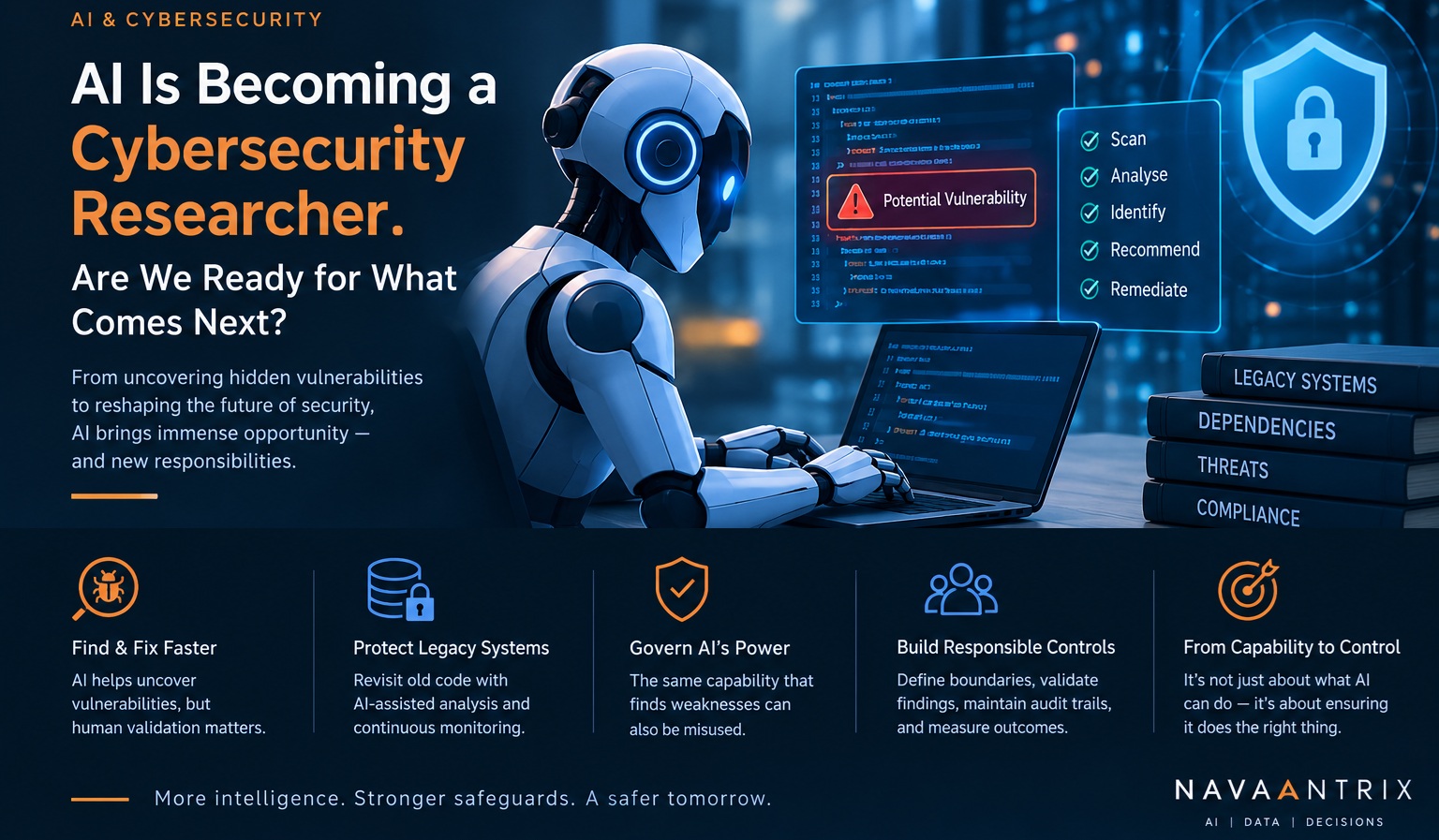
This week, AI uncovered serious flaws that had sat undetected in PHP for more than a decade, and governments took websites offline to respond. The real question for leaders is not whether AI can find weaknesses, but whether we can govern what happens next.
What happened
For more than a decade, serious flaws sat unnoticed in PHP, the open-source language behind a large share of the public web. BBC News describes it as a discovery that only AI brought to light and that triggered a global cyber-security alert.
The reported details point to a coordinated effort:
- Who found it: Security firms Wiz and Calif reported finding the flaws with AI. Wiz said it used its own autonomous research tool alongside frontier models from Google and OpenAI.
- How hard it was: Wiz said the flaws would have been extraordinarily complicated for a human attacker to exploit, and that AI removes that barrier.
- How serious it was: OpenAI, which said it led a coalition of researchers and providers for two months, called the issue one of the most impactful in recent memory. The FBI's cyber division warned it could allow remote code execution.
- The response: PHP released urgent fixes and urged everyone to update immediately. Some government websites went offline or ran in a reduced state, including in Finland and the Netherlands, while operators patched.
PHP is baked into WordPress, Drupal, Joomla and Magento, so a critical flaw in it spreads far beyond one codebase. Security researcher Costin Raiu described AI as powering a race to exploit. Early reports say attackers have already tried.
The double-edged sword
Vulnerability discovery has traditionally relied on researchers, code reviews, static analysis and penetration testing. AI adds another layer.
Depending on the model, tools and permissions it is given, it can help teams:
- Analyse large codebases for suspicious patterns.
- Examine dependencies and trace potential attack paths.
- Generate hypotheses about weaknesses a human might not consider.
- Help reproduce vulnerabilities and develop fixes.
- Speed up security testing and remediation.
But finding a potential vulnerability is not the same as proving it is exploitable. Findings still need validation, prioritisation and an honest assessment of real-world impact. Speed is valuable; accuracy and verification remain essential.
The PHP case also shows the other edge. A capability that lets a defender find a flaw lets an attacker find it too. AI does not distinguish between the two. Outcomes depend on who directs it, what access it receives, and what safeguards govern its use. As one security executive put it in coverage of the incident, the lesson is that AI is neither inherently dangerous nor inherently protective.
Why legacy software deserves renewed attention
Software outlives the teams, assumptions and documentation behind it. Code that was secure enough for its original threat environment can become vulnerable as dependencies, usage patterns and attacker capabilities change. PHP's decade-old flaws are a vivid example.
Legacy code brings four recurring challenges:
- Accumulated complexity: years of changes make behaviour hard to reason about.
- Hidden dependencies: one weak component can affect every application built on it.
- Limited institutional knowledge: the engineers who understood the design may be long gone.
- Competing priorities: security work loses out to new features.
AI-assisted analysis can help revisit these systems more systematically. A clean review should not be treated as permanent assurance. Organisations can use AI to support continuous examination of code, dependencies, configurations and emerging threats.
The goal is to shorten the time between discovering a weakness and resolving it, not simply to produce more vulnerability reports. The PHP response, with fixes and urgent updates, shows how much that gap matters once attackers are racing too.
Three levels of AI authority
The risk grows as AI gains tools that can run code, inspect repositories, touch networks or change production systems. It helps to separate three levels of AI-assisted security:
- Analysis: AI reviews code and recommends fixes.
- Assisted execution: AI runs approved tests in a controlled environment and proposes remediation.
- Autonomous action: AI initiates security operations, modifies systems or runs workflows with limited human intervention.
Each level delivers more operational value and demands stronger controls. A wrong recommendation is one kind of risk. A wrong action executed against a live production system is another. That is why AI capability and operational authority must be treated as separate design decisions.
Five controls for governed AI
Organisations should neither embrace unrestricted automation nor reject AI altogether. A practical framework has five controls:
- Define the operating boundaries. Specify which systems, repositories, networks and datasets an AI tool may access, and apply least-privilege permissions rather than broad access by default.
- Separate discovery from execution. Let AI identify and explain vulnerabilities before it gains authority to modify systems or deploy fixes. Use approval gates for consequential actions.
- Validate findings independently. Confirm that reported weaknesses are genuine, assess severity, and test proposed remediation before deployment.
- Maintain auditability. Record tool calls, actions, approvals and changes so teams can reconstruct what happened and why.
- Measure security outcomes. Track time to validate a vulnerability, time to remediate critical findings, recurrence of known weaknesses and the false-positive rate.
Together, these controls turn AI from an experimental capability into a governed operational asset.
Capability is not control
As AI grows more capable, it is tempting to assume that greater intelligence automatically yields better outcomes. It does not. A sophisticated system can still act on incomplete information, misread its operating context, or take an action that is locally correct but globally harmful.
Decision science has long made this point. The quality of an outcome depends on the quality of the information, the objectives being optimised, the constraints imposed and the feedback used to evaluate results. The same holds for AI.
A security agent needs more than the ability to spot a vulnerability. It must understand how critical a system is, what a failure would cost the business, how much risk is acceptable, and where its own authority ends. The PHP episode makes this concrete: when governments chose to take sites offline, they were weighing exactly those trade-offs.
The next frontier in AI is not just more capable systems. It is actions that are reliable, explainable, constrained and accountable.
What leaders should do now
This is not only a concern for CISOs and engineering teams. AI-enabled security touches business continuity, operational resilience, regulatory exposure and customer trust. Leaders can start with five questions:
- Where are AI tools already used in software development and security operations?
- What systems and information can they access?
- Which actions can they take independently?
- How are their outputs validated before they reach production?
- Who is accountable when an AI-assisted action causes an incident?
These answers set a baseline for responsible adoption. From there, introduce AI into well-defined workflows, test it in controlled environments, measure the results, and expand its authority only when the evidence supports it.
The aim is not to remove humans from every process. It is to put human oversight where it adds the most value and let automation handle the tasks it handles well.
Conclusion: build intelligence with responsibility
AI-assisted vulnerability discovery is a reminder that software security is never static. Capabilities once limited to specialised researchers are spreading, changing both the opportunities for defence and the nature of the threat.
The organisations that respond well will combine technical capability with disciplined engineering, clear governance and continuous validation.
At Navaantrix, our work in AI and decision intelligence reinforces a principle that applies equally to cybersecurity: technology creates value when its outputs can be trusted and turned into appropriate action.
The question is no longer whether AI can find a weakness. It is whether we can build the processes, safeguards and accountability to respond to that discovery safely.
As AI becomes more capable of acting on the world, responsible control becomes just as important as intelligence.
Sources
- BBC News: Websites went down around the world. Did AI stop it getting worse? (published Oct 22, 2026)
- Government websites go dark after AI-discovered flaw sparks security scramble (Oct 21, 2026)
- Some websites go dark as operators address an AI-detected flaw in a web programming language (Oct 21, 2026)
- Canada Pulls Government Websites After AI-Found PHP Flaws (Oct 21, 2026)
- AI Found a Decade-Old PHP Flaw: What Leaders Must Do Next (Oct 24, 2026)