Conversational AI Vs Static Reports
Posted on September 18, 2026
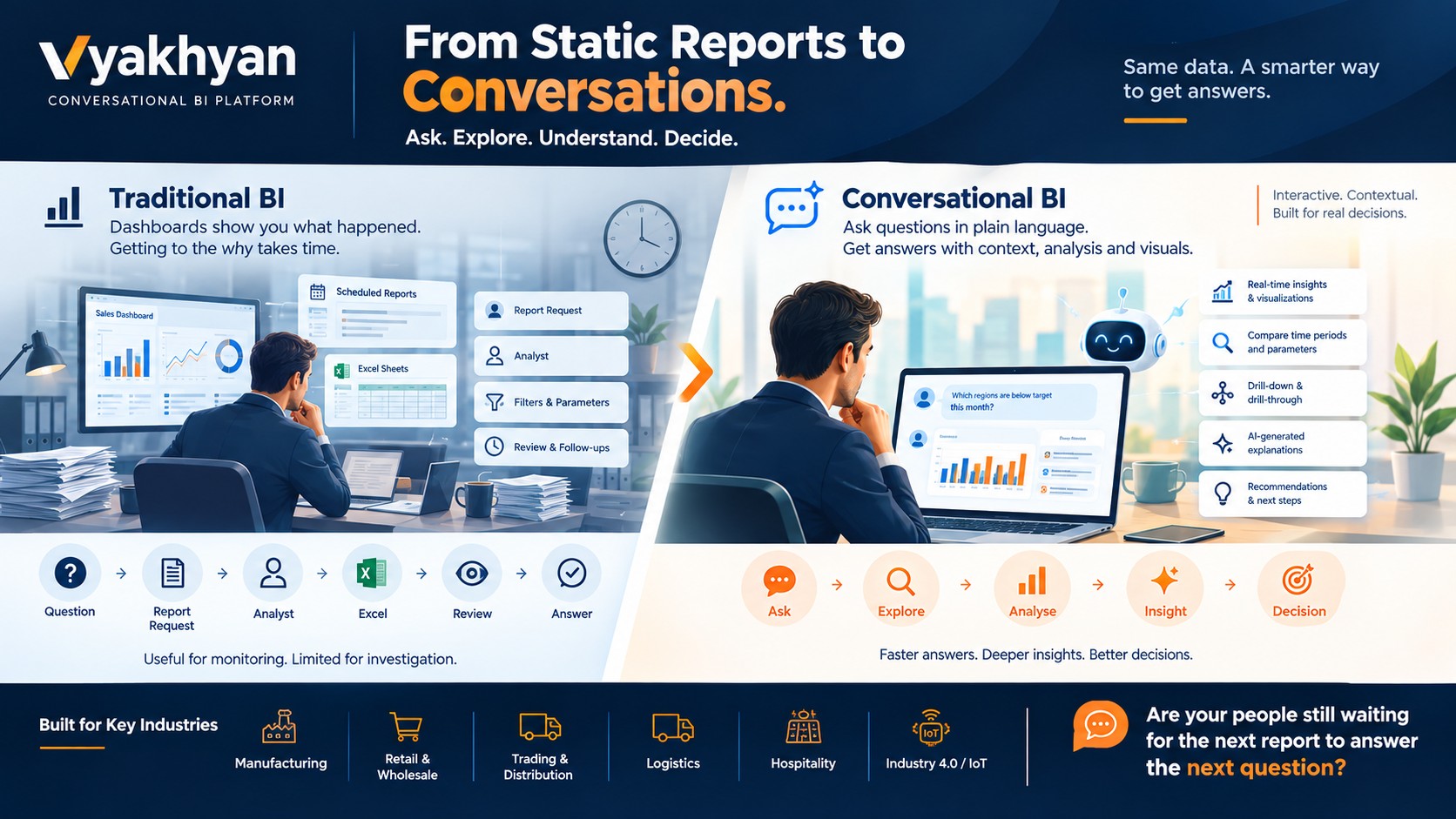
How Conversational AI Is Replacing Static Reports
Here's a pattern most businesses know too well.
Someone builds a dashboard. Management reviews it. A number looks off. Someone asks "why?"
And that's usually where the dashboard stops being useful.
The next question means another filter, another export, another Excel file, or another ping to the analyst. The dashboard answered the question it was built for. It just wasn't built for the question you're actually asking today.
That's the gap conversational BI is starting to close. And it's worth spending real time understanding, because it changes how a business actually runs — not just how it reports.
The reporting cycle that everyone tolerates but nobody likes
Walk into almost any mid-size or large business and you'll find some version of this cycle.
A manager needs a number. He/she messages the analyst, or the BI team, or whoever owns the report. The analyst pulls data from two or three systems — maybe the ERP, maybe a POS export, maybe a CRM report. The Analyst then cleans it, then puts it in Excel, then formats it, then sends it back.
By the time the report lands, a day or two has usually passed. Sometimes it's hours. Sometimes it's a week, if it needs to go through a review cycle first.
Nobody designed this on purpose. It built up over years, one report request at a time. But the result is the same everywhere: the people making decisions are structurally dependent on the people who can extract and format data. That's not a technology failure. It's a workflow that made sense when data lived in silos and nobody had a way to ask it questions directly.
The cost isn't just time. It's the decisions that don't get investigated because asking takes too long. A manager who has to wait two days for an answer stops asking the second and third follow-up questions. They act on the first number they get, even when it doesn't tell the whole story.
Dashboards are great at the questions you expected
This isn't an argument against dashboards. Dashboards solve a real problem, and they solve it well.
Take a standard sales dashboard. Revenue, orders, margin, region-wise numbers, target vs. actual, month-on-month growth. All useful. All fine, as long as the question matches what the dashboard was designed to show.
The problem starts the moment the question changes.
Say West region revenue is down 12% this month. The dashboard shows you that number clearly. What it doesn't do is tell you why.
Was it fewer customers? Lower order volumes? One product category dragging the whole region down? A pricing change that didn't land well? A handful of large accounts pulling back? Plain seasonality that happens every year around this time?
The data to answer any of those questions is probably sitting somewhere in your systems already. But getting from "what happened" to "why it happened" usually means a manual investigation — new filters, a fresh export, maybe a request to someone else who owns a different piece of the data. The report was built around a predefined set of questions. Business decisions are not.
This is the hidden limitation of static reporting that doesn't show up until you actually need to dig in. On the surface, everything looks fine — the dashboard is populated, the numbers update on schedule, everyone nods in the review meeting. It's only when someone asks the second question that the limitation becomes obvious.
A different way to work with data
Now picture the same situation, but instead of pulling a new report, you can just ask.
"Why did West region revenue fall this month?"
The system pulls together the relevant breakdown — not a static chart, an actual answer to that specific question.
Then: "Break that down by customer."
Then: "Which five customers caused most of the drop?"
Then: "Was that volume or price?"
Then: "How does this compare to the same period last year?"
Each question builds on the last one, the same way a real conversation would. That's not reading a report anymore. That's a conversation with your data.
This matters because it changes who can ask the question in the first place. Right now, digging into a decline like this usually needs someone comfortable with SQL, or someone who knows exactly which report tab has that breakdown. Conversational BI removes that requirement. The sales head, the plant manager, the CFO — none of them need to know where the data lives or how it's structured. They just need to know what they want to understand.
This isn't a fringe idea — the whole industry is moving here
It would be easy to dismiss this as a marketing angle if it were just us saying it. It isn't.
Gartner published research in September 2026 specifically on the shift from traditional BI dashboards toward analytics agents, describing natural-language interfaces as a core part of that transition. That's not a startup pitching a trend — that's one of the most conservative analyst firms in enterprise software documenting a shift that's already underway.
Microsoft is retiring its older Power BI Q&A feature in February 2027, actively pushing users toward Copilot for Power BI instead — a more integrated natural-language way of querying data. When a company the size of Microsoft sunsets an older feature in favor of a conversational one, that's a signal about where the whole market is headed, not an isolated product decision.
Tableau's current Tableau Agent capabilities let users ask questions in natural language, explore dashboards conversationally, compare periods, and investigate data — all while staying grounded in the underlying business context rather than guessing at answers.
Three different companies, three different products, one direction. BI is becoming more conversational. That's not a prediction. It's already happening in the tools most businesses use today.
But a chatbot bolted onto a dashboard isn't the same thing
Here's where it's worth slowing down, because this distinction gets glossed over a lot.
Putting a chat window next to your existing dashboard doesn't automatically make it useful. A lot of "AI-powered" BI features in the market today are exactly that — a thin conversational layer sitting on top of the same reports, answering surface-level questions and stopping there.
A conversational BI system that actually works needs to understand several things at once.
The data itself. What does each field actually mean? Which system is it coming from? How current is it — real-time, hourly, or last night's batch load? A system that doesn't know this will confidently give you an answer based on stale or mismatched data, and you won't know until it's already caused a problem.
Your business context. What does "sales" mean in your organization specifically — gross bookings, net of returns, invoiced revenue? How is margin actually calculated? What counts as an "active customer" — anyone who's ever bought from you, or someone who's purchased in the last 90 days? These definitions vary business to business, and a generic AI model won't know your definitions unless it's been given them.
Who's asking. A CFO's questions about receivables and cash flow look nothing like a warehouse manager's questions about stock-outs, and neither looks like a shopfloor supervisor asking about machine downtime. The same underlying data needs to answer very different questions depending on the role of the person asking.
What kind of answer the question actually needs. Sometimes the right response is a comparison. Sometimes it's a segmentation. Sometimes it's a full root-cause breakdown across five variables. A system that just returns a number every time isn't actually solving the problem — it's just answering faster, which isn't the same thing as answering better.
Governance. This one gets skipped over most often, and it's arguably the most important for any enterprise. Who's allowed to see what data? Which sources should the system trust when two systems disagree? What should the AI be allowed to infer versus what should it explicitly say it doesn't know? Tableau's own conversational features are built around governed data and metrics specifically because an enterprise can't afford an AI system that treats itself as a general-purpose chatbot with access to sensitive business data.
Skip any one of these, and you don't get conversational BI. You get a chatbot that sounds confident and is sometimes wrong — which, in a business context, can be worse than no chatbot at all.
So are dashboards going away?
No. And we don't see it that way at Navaantrix either.
A dashboard is still the right tool the moment you already know what you want to monitor. A plant manager wants OEE visible on one screen, all the time, without asking for it. A CFO wants receivables, cash flow, and margins tracked continuously. A sales head wants revenue and regional performance visible the second they open their laptop in the morning.
Dashboards give a team a shared, always-on view of the business. That's genuinely useful and it isn't going anywhere.
Conversation becomes valuable the moment someone wants to go past that shared view — to investigate something the dashboard wasn't specifically built to explain. That's a different job, and trying to force a dashboard to do it usually just means more filters, more custom reports, and more dependency on whoever built the thing in the first place.
So the model that actually works looks like this:
Dashboard for monitoring. Conversation for investigation. AI for explanation and prediction.
Put those three together and you get something meaningfully more useful than any one of them alone — which is exactly the gap we built Vyakhyan to close.
This is exactly why we built Vyakhyan the way we did
Vyakhyan didn't start as "let's build another dashboard product." It started from a simpler, more specific observation: decision-makers weren't actually asking for more data access. Most of them already had dashboards. What they were asking for, over and over, was an answer to a specific question, right now, without going through someone else to get it.
The earliest version of Vyakhyan actually came out of two completely unrelated projects. One was a KPI analytics engagement for a multi-store retail chain — the kind of setup where every store manager needs a slightly different slice of the same underlying sales data. The other was a contract analysis project using retrieval-based AI, where the challenge was pulling specific answers out of long, unstructured legal documents.
Different industries, different data types, same underlying need: ask a specific question, get back the relevant data and analysis, without first learning a new BI tool or waiting on someone else to run a query.
That thinking is still at the core of the product. Vyakhyan combines conversational querying with interactive dashboards, historical comparisons, drill-downs, AI-generated insights, and an organizational knowledge layer that works across both structured data (your ERP, POS, CRM, databases) and unstructured information (documents, contracts, reports). The goal was never to teach people a new interface. It was to make the interface match how people already think:
Ask → explore → understand → decide.
Where this actually matters most
This gap between data availability and decision-making shows up most sharply in businesses that generate data continuously but still depend on someone to manually turn it into a report before anyone can act on it.
Manufacturing. Production output, quality rejection rates, OEE, unplanned downtime, maintenance schedules. A plant head asking "which line is underperforming and why" shouldn't need to wait for the weekly MIS report to find out.
Retail and wholesale. Store-level performance, SKU movement, customer footfall patterns, margins by category. A regional manager comparing this month's numbers against last month across fifteen stores shouldn't need fifteen separate spreadsheet tabs to do it.
Trading and distribution. Sales performance, inventory positions, receivables ageing, territory-level trends. A sales director asking which distributors are behind on payments should get that answer in the same minute they ask, not after a finance team pulls a report at month-end.
Logistics. Dispatch schedules, delivery performance, turnaround times, exception handling. An operations head trying to understand why delivery times spiked in one region needs to investigate in real time, not after the fact.
Industry 4.0 and IoT. Machine-level sensor data, production parameters, anomaly detection, predictive maintenance signals. A shopfloor supervisor noticing an unusual pattern needs an answer before it turns into unplanned downtime, not after.
None of these businesses lack data. If anything, they usually have too much of it, spread across too many systems. What they lack is a short, reliable path between the data that's already being generated and the decision someone needs to make in the next five minutes.
What this actually looks like in a real review meeting
It's worth being concrete about what changes day to day, because "conversational BI" can sound abstract until you picture the actual meeting.
Right now, a typical weekly review might go like this: someone presents last week's numbers from a pre-built deck. A number looks off. Someone says "let's get the analyst to pull the breakdown and we'll discuss it next week." The meeting moves on. The follow-up either happens a week later, once the moment has passed, or it quietly never happens at all.
With a conversational system sitting on top of the same data, that meeting looks different. The number looks off. Someone asks the follow-up question right there, out loud, and gets an answer inside the meeting. The next question gets asked immediately after, because there's no cost to asking it. By the time the meeting ends, the team hasn't just seen the numbers — they've actually understood what's behind them, and they can decide on next steps before everyone leaves the room.
That's the real change. Not a new interface. A shorter distance between noticing something and understanding it.
From "what happened" toward "what happens next"
There's a second layer to this worth mentioning, because conversational querying is really just the first step.
Traditional BI, no matter how well built, is fundamentally backward-looking. It tells you what happened last week, last month, last quarter. That's necessary, but it's not sufficient for a business trying to get ahead of problems instead of reacting to them after the fact.
The more useful questions sit further down the chain: why did it happen, what's likely to happen next if nothing changes, and what should actually be done about it. That's why Vyakhyan doesn't stop at answering questions about the past — it also includes forecasting, what-if simulation, and AI-generated recommendations, so a business can move from explaining last month's numbers to actually planning for next month's.
The real shift isn't dashboards vs. chat
It's reports vs. questions.
For years, BI has been built around one central question: "what report should we create?" That question makes sense from a BI team's perspective, but it quietly puts the BI team in charge of deciding what questions are even askable. If a report doesn't exist for a particular breakdown, that breakdown effectively doesn't exist for the business user trying to make a decision.
The better starting question is: "what decisions do people actually need to make?" Once you start there, the whole approach changes. Instead of building a new dashboard or a new report for every scenario anyone might eventually ask about, you build a trusted, well-governed data foundation and give people a natural way to explore it — one that doesn't require anticipating every question in advance.
That's what makes conversational BI worth paying real attention to, beyond the novelty of talking to a chatbot. It isn't replacing analytics. It's removing the friction that sits between a business having data and a person actually getting a useful answer from it.
A static report answers the question someone anticipated when they built it, months or years ago. A conversational system lets you ask the question you actually have, today, and then lets you ask the next one after that. Most of the time, the real insight isn't in the first answer. It's in the third or fourth follow-up question — the ones that never get asked when asking is expensive.
What's one question your management team keeps asking that still needs an analyst, an Excel file, or a fresh report to answer?
Drop it in the comments. If it sounds familiar, we can show you how Vyakhyan handles it using your own business data — book a demo and bring your toughest question with you.
#Vyakhyan #ConversationalBI #BusinessIntelligence #AIAnalytics #DecisionIntelligence #NaturalLanguageBI #EnterpriseAI #ManufacturingAnalytics #RetailAnalytics #SupplyChainAnalytics #Industry40 #Navaantrix